




Unlike geographic poles, magnetic ones tend to walk freely for tens of kilometers a year. In 2019, this movement was so fast and unexpected that the scientists in charge of the World Magnetic Model had to urgently adjust the representation of the Earth's magnetic field. The displacement rate over the past 20 years has grown from 15 kilometers per year to 55. What is the threat of such a fast drift of the magnetic pole?
There is nothing unusual about the displacement of the magnetic north pole. When, during the expedition in 1821, the direct point to which the compass points was first discovered, was on the Boothia Peninsula in the Canadian Arctic. 70 years later, Norwegian Amundsen rediscovered the magnetic north pole 50 kilometers from the first location. For the next 90 years, the pole migrated northward at a speed of about 15 kilometers per year.
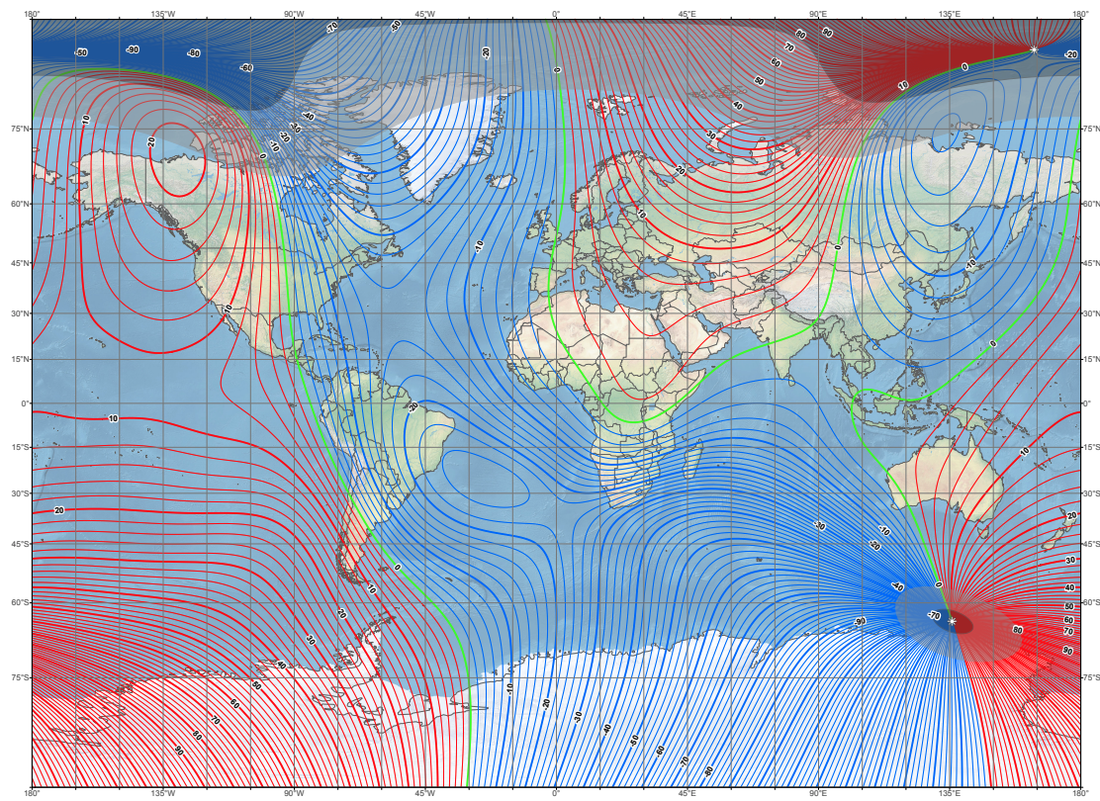
But in the 1990s, the movement of the point to which all our compasses point only accelerated. By 2017, this point crossed the geographic North Pole and continues to move towards Siberia and the Taimyr Peninsula. During this time, the speed of movement has quadrupled and now is 50-60 kilometers per year.

"By 2040, all compasses are likely to be pointing east of true north, " said scientist Ciaran Beggan of the British Geological Survey, which tracks the movement of the magnetic north pole. " For the past 350 years, magnetic north has wandered over the same part of Canada."
The Geological Survey, along with colleagues from the United States, is collecting information for the World Magnetic Model, a large-scale spatial representation of the Earth's magnetic field.
This magnetic shell around our planet protects all life from the deadly and destructive solar radiation. Without it, the Earth today could look like Mars: the solar wind would blow away the life-giving atmosphere and deprive the planet of oceans and vegetation.
During the expeditions of automatic spacecraft to Mars, it was revealed that the magnetic field of this planet has a strength 500 times weaker than the earth's. It is extremely unstable.
Pole inversion
The Earth's magnetic field can also weaken in cases where an inversion occurs: the north and south magnetic poles change places, and the compass needle begins to point in the opposite direction. In the history of human existence as a living species, this has not happened.
However, in the history of the planet, there have been magnetic field inversions, and this happened more than once. Over the past 80 million years, scientists have counted 183 such reversals. And they were statistically completely random in nature, scientists did not find any patterns or periodicity during the research.
At the same time, estimates of how quickly such reversals occurred are also very different. Some experts estimate that on average it takes 7,000 years to complete a reversal. The last reversal, which took place 780 thousand years ago, took place in 22 thousand years, according to scientists.

Although there have been cases when the reversal occurred in just a few hundred years. This was the case, for example, at the end of the last ice age, about 41 thousand years ago. We are talking about an event called the Lashamp-Kargapolovo paleomagnetic excursion. It was not a complete inversion, but an excursion: the polarity changed, but the magnetic field soon restored its previous polarity.
The German Research Center for Geosciences published a paper on this event in 2012. Scientists wrote that 41 thousand years ago a compass in the Black Sea region pointed to the south. How will they know about it? By analyzing the magnetization of oceanic sediments and lava flows.
"The geometry of the field of reverse polarity, with lines of force oriented in the opposite direction compared to today's configuration, lasted only about 440 years, and this was due to the field strength, which was only a quarter of today's, " said one of the lead authors of the work, Norbert Novachik ...
The actual polarity reversal only lasted 250 years. In terms of geological timescales, this is very fast.
During this period, the magnetic field was even weaker - only 5% of its current strength. As a result, the Earth has almost completely lost its screen, which protects it from hard cosmic rays, the radiation effect has increased significantly. This is supported by peaks of radioactive beryllium, which was found in ice cores recovered from the Greenland ice sheet. They arose as a result of the collision of high-energy protons with atoms in the planet's atmosphere.
Scientists note that in the past 200 years, the Earth's magnetic field has decreased by about 10%. Coupled with the accelerated drift of the northern point, one could speculate that a change in the planet's magnetic poles is coming. However, this process can be so long that by the time of complete inversion, human civilization will look completely different.
But the drop in the magnetic field strength that accompanies the inversion makes the Earth less protected from hostile cosmic radiation. Soon after the first chronological reversal maps were compiled, scientists began comparing them with the planet's known mass extinctions.
Indeed, some periods of reversals coincided with periods of geological catastrophes and a significant reduction in biota. But due to the extreme complexity of such studies and the lack of information, it is almost impossible to find any clear relationships. Indeed, the inversion may not be the cause, but the consequence of such an extinction, which began as a result of the fall of a large asteroid, followed by volcanic activity and inversion.
What is known for sure is that a shift in the magnetic north pole will mean a shift in the auroras. Who knows where they will be observed in the next thousand or hundreds of years.
Why is the magnetic pole drifting?
How do scientists explain the displacement of the magnetic north pole? It must be understood that the magnetic field is created thanks to the iron-rich core of the planet, which is in constant rotation. Like any magnet, he has south and north. The magnetic pole is where the field runs perpendicular to the Earth's surface and where the freely rotating magnetic needle will point straight down.
We know from physics textbooks that the magnetic field lines enter the south pole and out of the north pole. So from the point of view of science, in the north we actually have the south magnetic pole, and in the south - the north. But the earthlings agreed to abandon this convention in order to avoid confusion. So let's turn the page and forget this step away from the narrative.
Philip Livermore and his colleagues from the University of Leeds in the UK, in a relatively recent scientific work, came to the conclusion that the movement of the magnetic pole in the north is associated with a "tug of war" between two sections of negative magnetic field near Canada and Siberia. In recent years, the Canadian spot has weakened significantly, which allowed the Siberian to pull the pole in its direction. In the next ten years, the pole will continue to move towards Siberia and cover a distance of 660 kilometers.
“Between 1999 and 2019, there was a slight increase in the Siberian patch, while the absolute value dropped significantly in the Canadian area, ” Livermore comments.

A team of scientists modeled this change in tension to find out what caused the changes in the Earth's core, and concluded that around the 1970s, there was a change in the flow of liquid iron in the core.
In the last 7 thousand years, the north magnetic pole has been randomly moving around the geographic, following the unpredictable flux of iron in the core. And wherever he goes now, it is safe to say that he is unlikely to stay there for long.


 Posts


There's still so much we don't understand about why the magnetic pole moves around randomly, and at different speeds over the years? Someday they will figure it out, and likely attribute it to the circulating magma in the Earth's core?
ReplyDelete